
Rooftop HVAC equipment is designed to move air, maintain comfortable temperatures and support the everyday operation of a building. But the fans, compressors, motors and other moving components inside that equipment can also produce unwanted noise and vibration. While sound and vibration are closely related, they aren’t the same problem, nor are they always solved the same way.
A rooftop unit that can be heard in an office directly below may require a sound reduction solution. Equipment that causes noticeable shaking or transfers mechanical energy into the building structure may call for vibration isolation. In some applications, both conditions exist at the same time.
Understanding the difference between sound reduction and vibration isolation helps engineers and contractors select a rooftop solution that addresses the actual source of the problem instead of treating all unwanted noise and movement as one issue.
What Is Vibration Isolation?
All mechanical equipment produces some degree of vibration during operation. Motors turn, fans rotate and compressors cycle on and off. When rooftop equipment is mounted directly to a curb or support, some of that mechanical energy can be transferred from the equipment into the supporting structure. Vibration isolation is designed to interrupt or reduce that transfer.
Rather than allowing mechanical vibration to travel directly from the rooftop unit through its support and into the building, an isolation system creates separation between the equipment and the structure. Springs or other isolating components absorb and reduce the mechanical energy before it can be transmitted farther into the building.
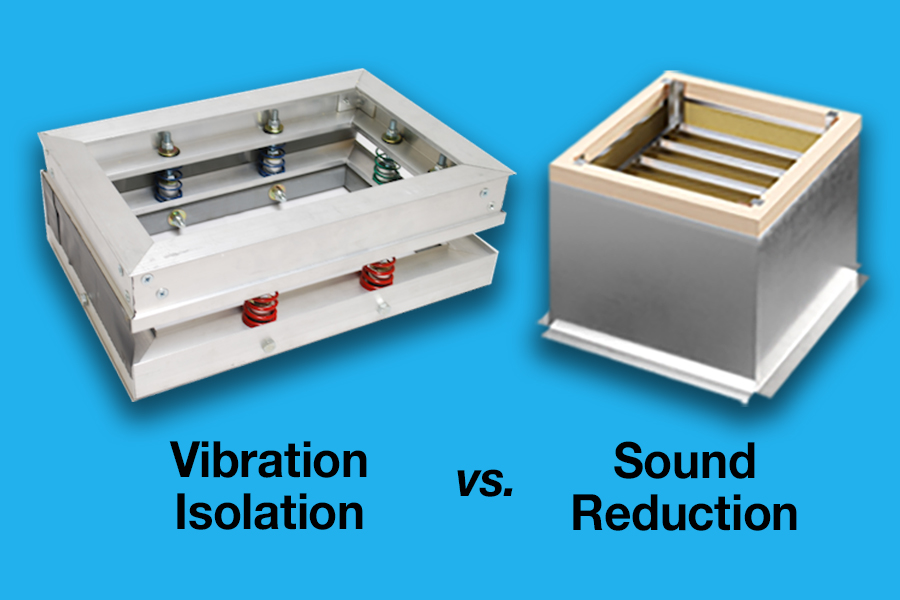
Pate’s Vibration Isolation Rails (PVIR) are designed specifically for this purpose. The system can be used with roof curbs or equipment supports to reduce the mechanical vibration transmitted by rooftop HVAC equipment.
This becomes especially important when rooftop equipment is located above occupied spaces where vibration could be noticeable or disruptive. It can also help address the long-term effects that equipment vibration can have on the rooftop installation and supporting structure.
What Is Sound Reduction?
Sound reduction addresses unwanted noise. Rooftop equipment can create airborne sound that travels through the curb and roof assembly into the building below. Depending on the equipment and application, that noise may come from supply and exhaust fans, compressors, condenser fans or other components inside a rooftop unit.
Pate’s Sound Reduction & Vibration Isolation products include two different solutions specifically designed to address sound: the Pate Sound Curb (PSC) and Pate Sound Shield (PSS). The Pate Sound Curb is an in-curb sound reduction treatment engineered for small supply and exhaust fans. Acoustical baffles inside the curb absorb unwanted sound waves, helping reduce the noise transmitted through the opening.
The Pate Sound Shield takes a different approach. It uses an acoustic barrier and insulating layer inside the roof curb to reduce radiated sound from rooftop equipment. Because it addresses noise from multiple sources within a rooftop unit, it can be applied across a wider range of applications.
Why Sound and Vibration Are Easy to Confuse
A person sitting beneath rooftop equipment may simply notice that the unit is “noisy.” What they are hearing, however, could have several causes. Airborne noise may be passing through the curb and roof assembly, while mechanical vibration from the same equipment could be traveling through the structure and creating additional sound elsewhere in the building.
Adding sound-absorbing material won’t necessarily prevent mechanical vibration from being transmitted into the structure. In the same way, isolating the equipment from the building may reduce vibration without addressing airborne noise traveling through the curb.
When Does Vibration Isolation Matter?
Vibration isolation becomes important when mechanical energy from rooftop equipment is being transmitted into the building structure or when a project calls for that transmission to be minimized from the start.
Reducing or eliminating vibration is not only relevant when building occupant sensitivity to mechanical disturbances is a concern. It also reduces wear and mechanical fatigue on the building structure and other nearby components, as well as on the equipment itself.
Pate’s PVIR system uses spring isolation to reduce vibration transfer while also incorporating seismic and wind restraints. The rails are shipped with springs and restraints in place, eliminating the need to assemble those components on-site. They can also be factory attached when ordered with new Pate curbs or supports.
The seismic and wind restraint component is an important distinction because isolating a piece of equipment doesn’t eliminate the need to keep it securely attached to the building.
When Does Sound Reduction Matter?
Sound reduction becomes the focus when the primary concern is noise generated by rooftop equipment reaching the spaces below. Occupied commercial buildings can have very different acoustic expectations than a warehouse or industrial facility. Equipment that performs acceptably in one environment may be disruptive in another simply because of where it is installed and how the space below is used.
The type of equipment also matters. A small rooftop supply or exhaust fan presents a different acoustical challenge than a larger packaged rooftop unit containing multiple noise-producing components.
This is why we offer more than one sound reduction approach. The Sound Curb provides an in-curb solution for smaller fans, while the Sound Shield can be applied to a variety of plenum and non-plenum curbs to reduce radiated sound from rooftop equipment.
When You Need Both Sound Reduction and Vibration Isolation
The same rooftop unit can produce airborne noise and mechanical vibration simultaneously. Reducing only one may leave building occupants experiencing problems caused by the other.
A more complete approach looks at the rooftop equipment, curb, supports and building structure as a system. The goal is to determine how sound and vibration are being transmitted and then select the appropriate combination of products to control them.
This is particularly valuable during the design phase of a project. Addressing acoustical and vibration concerns before equipment is installed gives engineers and contractors an opportunity to incorporate the necessary components into the rooftop assembly instead of trying to correct a problem after the building is occupied.
Our sound reduction and vibration isolation products are designed to work with our broader line of rooftop support solutions. For specialized projects, Pate can also provide engineered-to-order rooftop products to address requirements that aren’t met by a standard configuration.
Choosing the Right Solution for Rooftop Equipment
The right approach depends on the equipment being installed, the building structure, the space below, the amount and type of noise being produced and the project’s performance requirements.
We’ve worked with mechanical and HVAC contractors for more than 60 years, providing rooftop support products for new installations, retrofits and specialized applications. Our sound reduction and vibration isolation products extend that experience to another important part of rooftop equipment performance.
Pate also offers engineering resources for projects with more specialized requirements. Our engineering and technical services include load modeling, professional engineering services and product training, helping engineers and contractors address project-specific rooftop requirements.
Control Rooftop Sound and Vibration with The Pate Company
Sound reduction and vibration isolation solve related but distinctly different problems. Sound reduction focuses on limiting unwanted noise generated by rooftop equipment, while vibration isolation reduces the transfer of mechanical energy from the equipment into the building structure.
Understanding that difference makes it easier to specify a solution that addresses the real source of a problem, and to recognize when both types of protection may be needed.
If rooftop equipment noise or vibration is a concern on your next project, explore Pate’s Sound Reduction & Vibration Isolation products or contact us to discuss the application with our team. We can help determine which solution makes the most sense for your equipment, building and project requirements.